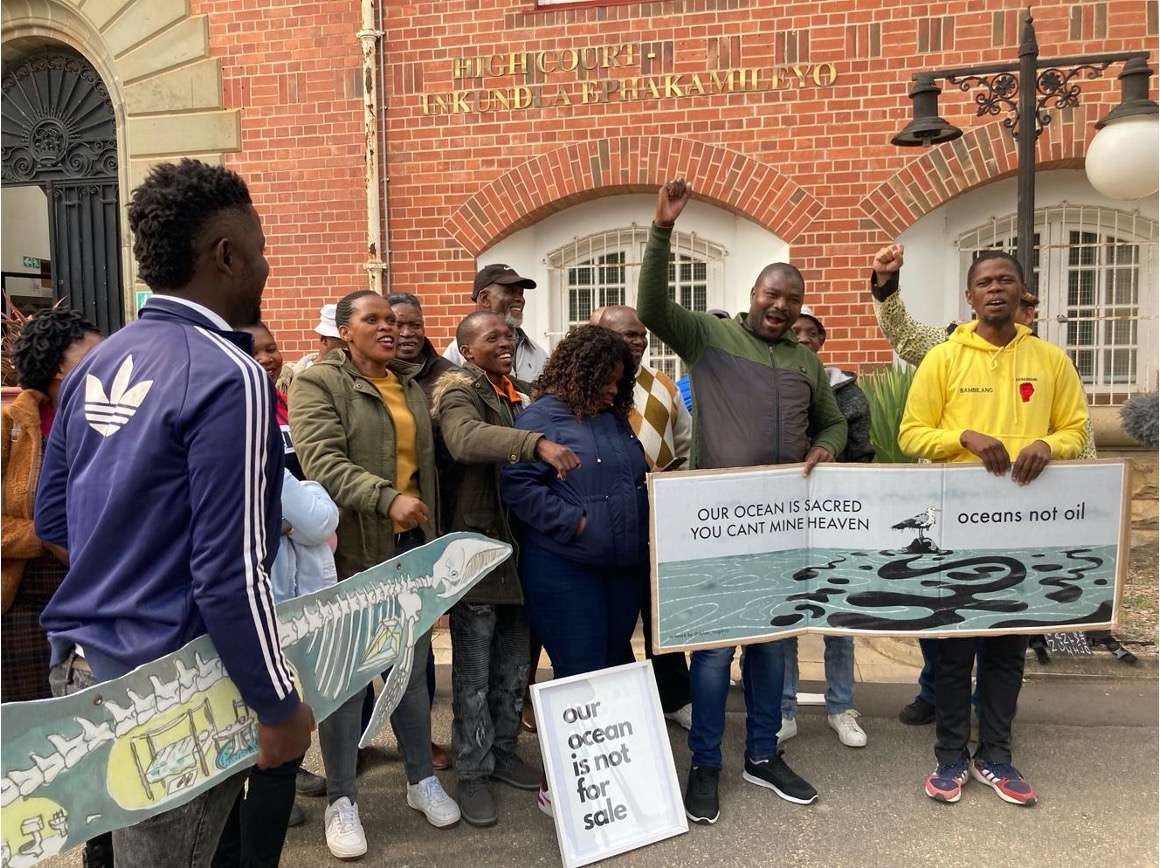
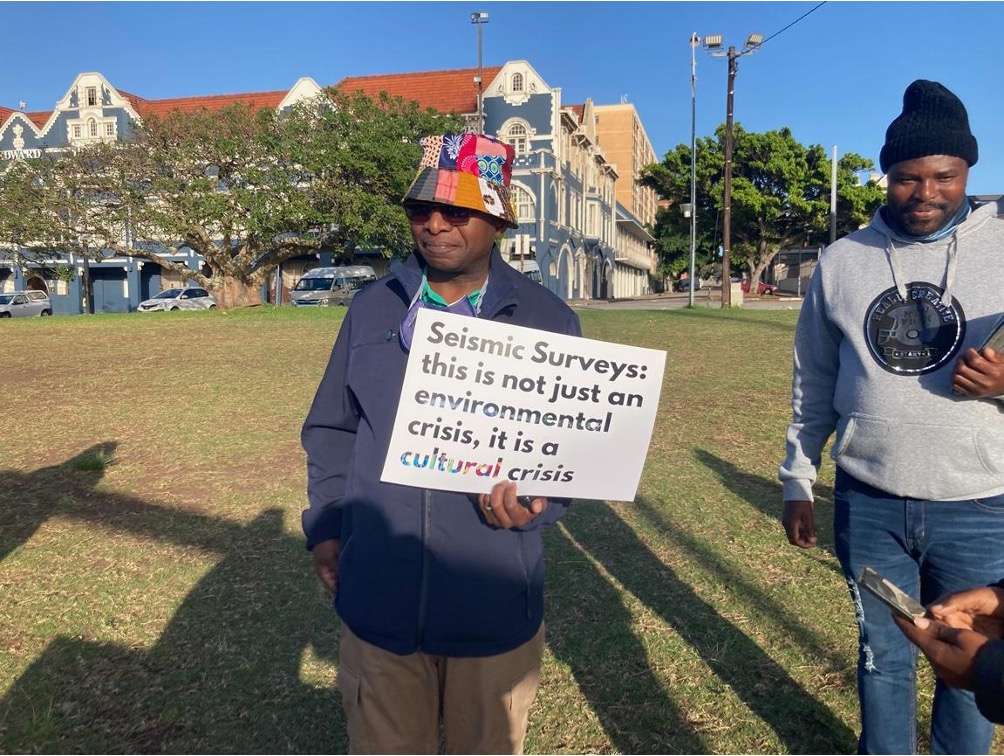
In South Africa, the collective efforts of ocean-defending small-scale fishers and their social partners led to two successful court cases in 2022, to stop multinational companies from conducting seismic surveys for oil and gas.
The push for developing offshore oil and gas production in South Africa’s deep sea, under the banner of the Blue Economy strategy ‘Operation Phakisa’, has led to the South African government granting exploration permits covering 98% of South Africa’s Exclusive Economic Zone (Roux, 2017; Sunde, 2022). As small-scale fishers and their social partners in community-based organizations, universities, and NGOs became aware of specific seismic surveys about to commence in late 2021 / early 2022, with little to no public consultation regarding these surveys, they launched a broad and strategic resistance. This included large public demonstrations on beaches and outside Shell petrol stations around the country (France 24 English, 2021); communications (Coastal Justice Network, 2022), story-telling (Empatheatre, 2021), and advocacy (Masifundise Development Trust, 2021) aimed at raising public awareness; letters and petitions (Oceans Not Oil Coalition, 2021); and ultimately legal action.
The resistance efforts in 2021/ 2022 focused on two permits granted by the government for conducting seismic surveys to explore oil and gas without the prior consultation of local communities. Small-scale fishers were at the heart of both of these successful campaigns, as they strongly asserted their identity as ocean defenders whose rights – related to participation, livelihoods, and cultural and customary relationships – had been violated in the granting of these exploration permits. They also voiced deep concerns about the impacts of seismic blasting on plankton, fish, whales, birds, and other marine life with whom fisherfolk share the ocean. An underlying worry was about the potential future impacts of oil extraction, processing activities, and potential spills in the region on ocean health, fish populations, fisheries-dependent livelihoods, and human health. Furthermore, they raised concerns about the continued exploitation of fossil fuels at a time when fishers are already observing the worrying impacts of climate change on both ocean ecosystems and coastal communities.
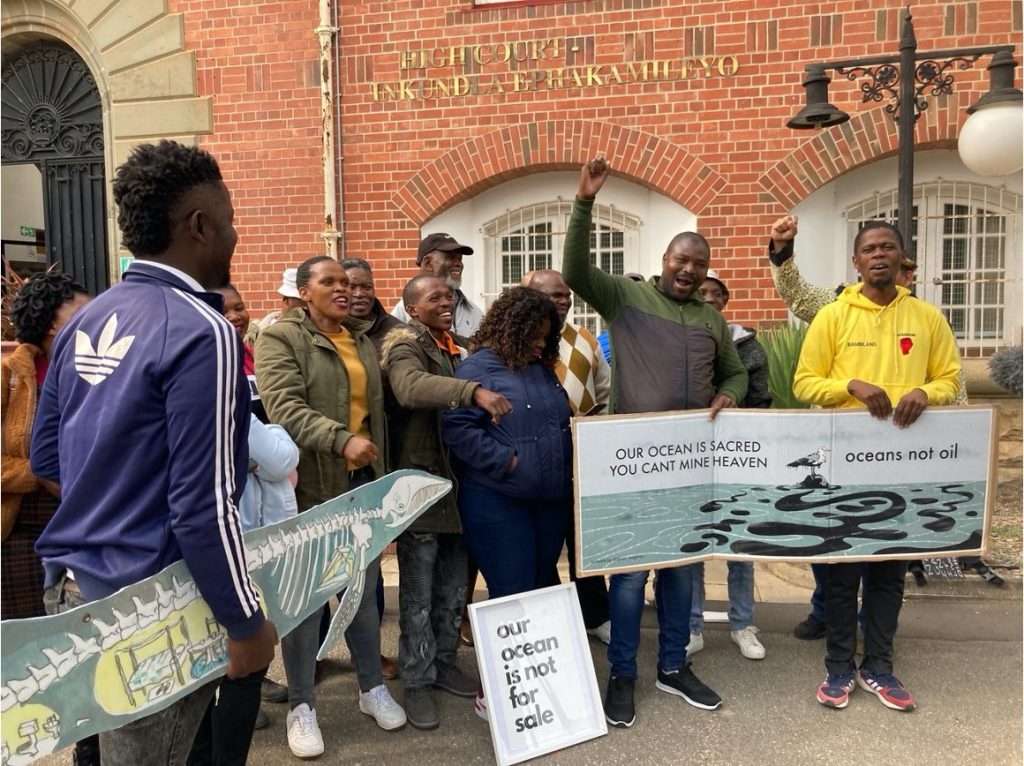
The first case took place along the Eastern ‘Wild Coast’ of South Africa. Here, small-scale fishers learned in November 2021 that a company called Impact Africa, in partnership with Royal Dutch Shell, was about to start a large-scale seismic survey, without any meaningful consultation of the people living along that coastline. With support from human rights lawyers, researchers, and civil society partners, applicants from fishing communities along this stretch of coastline launched legal proceedings against South Africa’s Department of Mineral Resources and Energy, Impact Africa, and Shell. These legal proceedings had the intent to get an urgent interdict and then revoke the exploration permit entirely. The founding affidavit in this case, containing the statements of Mr. Sinegugu Zukulu and other community-based ocean defenders and small-scale fishers, expresses the ‘ocean defender’ identity of these applicants very clearly:
“The Wild Coast is a place of stunning natural beauty. Unlike other coastal stretches in South Africa, indigenous people have maintained continuous possession of this land despite waves of colonial and Apartheid aggression. This is no accident. Our ancestors’ blood was spilled protecting our land and sea. We now feel a sense of duty to protect our land and sea for future generations, as well as for the benefit of the planet.
Our land and sea are central to our livelihoods and way of life. Over generations, we have conserved them, and they have conserved us.…
Multinational corporations now wish to blast our sea every ten seconds for five months with air gun bursts between 220 and 250 decibels – louder than a jet plane taking off – that will be heard underwater more than 100 kilometers away. They want to do this for one reason – to look for oil and gas that they can profit from while worsening the planet’s climate crisis… “ (Sustaining the Wild Coast NPC and Others v Minister of Mineral Resources and Others, 2021).
The judges, in this case, found in favor of the community applicants, first granting an urgent interdict to stop the seismic survey from commencing until the full case was heard, and then ultimately setting aside Shell and Impact Africa’s exploration permit entirely (Centre for Environmental Rights, 2021). Shell is appealing that judgment, with a court date expected sometime in late 2023. The judges affirmed the role of the applicants as custodians of the ocean (Pereira Kaplan, 2022). They recognized their cultural, customary, and livelihood rights, as well as found that their right to be consulted had been violated.
At the very same time as Wild Coast fishers were celebrating their first victory in securing an interdict to stop Shell’s seismic survey, news broke of another seismic survey about to begin. In early 2022 small-scale fishers on the West Coast got the disturbing news that an Australian company called ‘Searcher Geodata’ was about to start a seismic survey along their coastline. The public interest that had been galvanized around the Wild Coast Shell case now turned its attention towards the Searcher West Coast case. Again, it was the deep intergenerational knowledge and guardianship of small-scale fishers, particularly West Coast snoek fishers, that guided and strengthened the collective response to this case.
Below is an extract from the founding affidavit submitted by Mr. Christian Adams and others in the case that West Coast small-scale fishers brought against the South African government and Searcher:
“The fishers with whom I fish have a deep knowledge of the ocean ecosystem. I know that like me, this knowledge has been passed down over several generations of fishers. We know the sea in so many ways: we can tell what fish will be available by looking at the sky, by smelling the wind, by feeling the wind against our faces. We know this West Coast and the way that the sea and the weather interact here as if it was part of us… This traditional knowledge is part of our culture, it is who we are. We did not learn this knowledge at university but as a culture, the West Coast traditional fishers hold the knowledge of generations of ocean guardians…
We are witnessing the impact of large-scale industrial developments along our coast and increasingly, in our waters. We believe that this will have a lasting negative impact on our fish stocks that we depend on for our food and livelihoods. We know that our snoek will be impacted by seismic noise and it will alter the course of the snoek…
Not only does this pose a risk to the actual catching of our fish, but it poses a risk to our culture and who we are as fishers of the West Coast. Our ability to feed our families and our communities, to extend a helping hand to our neighbors who are struggling, depends on us having a good catch. If we cannot continue this custom, it will impact not only the physical health of our communities but also the social fabric and customs that make up who we are as a people. For this reason, we do not understand why our government is giving permits that will impact our way of life and our livelihoods negatively and we do not understand why we are not consulted about this.” (Adams and Others v Minister of Mineral Resources and Energy and Others, 2022).
An interdict was granted by the Western Cape High Court in March 2022, leading Searcher Geodata to call off their proposed seismic survey and leave South African waters (Centre for Environmental Rights, 2022). In early 2023, Searcher re-applied and was granted environmental authorization to carry out a seismic survey on the West Coast (Omarjee, 2023). There is an appeal process underway, and a decision regarding these appeals is still pending (Engel, 2023).
The success of these ocean defenders has been met with polarizing discourse from the Minister of Mineral Resources and Energy, who has said that environmental activists resisting oil and gas are ‘CIA funded’ or ‘foreign-funded agents’ blocking economic development (Nyathi, 2023; Makinana, 2023), and intent on ‘apartheid and colonialism of a special type’ (Sgqolana, 2021). There have been worrying reports of more directly threatening statements being made to communities warning them that if they continue to resist developments including oil and gas exploration they may get hurt or killed (Higginbottom, 2023). This should be taken extremely seriously in the context of the assassinations and other physical threats against environmental human rights defenders in South Africa (Nkosi and Koko, 2020; groundWork et al., 2019). Energy companies have adjusted their tactics to ensure they are able to show greater evidence of ‘consultation’, despite continuing to ignore or undermine the voices of ocean defenders, and are still intent on overturning the courts’ decisions against them.
The struggle is far from over. However, small-scale fishers and their networks continue to monitor and respond to oil and gas exploration and production, including by Total, Shell, and other multinationals (Masifundise Development Trust, 2023). As one can see in the affidavit extracts, small-scale fishers have a strong identity as ocean defenders, applied powerfully in both of these cases to resist large-scale, non-consultative, and ocean-threatening activities. Building international solidarity between ocean-defending small-scale fishers and their allies standing up to Big Oil and Gas should be pursued.


